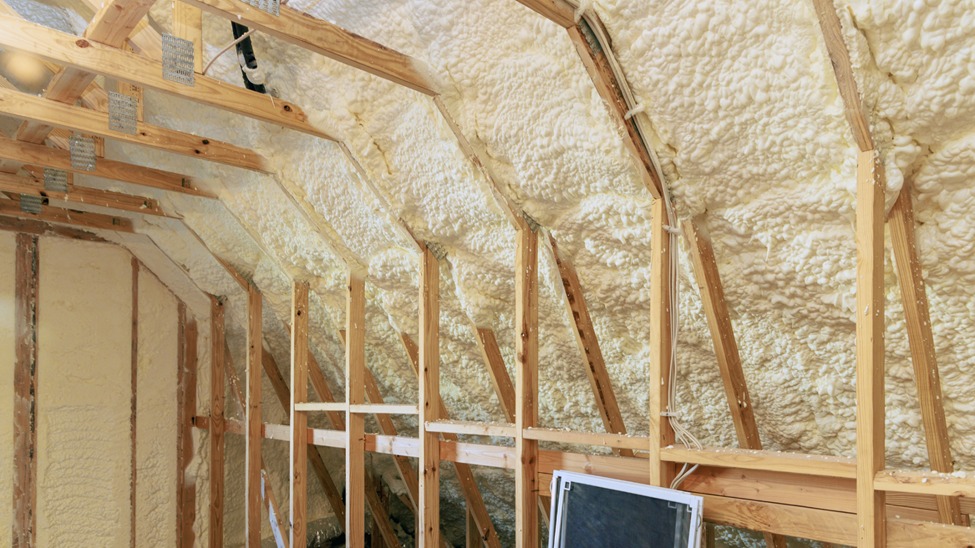
If you ask any building performance professional what single insulation upgrade delivers the most immediate improvement in a home's comfort and efficiency, spray foam insulation comes up consistently. It is not just an insulator, it air seals and insulates in a single pass, addressing two of the biggest sources of energy loss at the same time. Here is what that means for your home in practical terms.
Spray foam is a two-component product. When the two chemicals combine at the spray tip, they react, expand, and cure into a foam that fills every gap, seam, and penetration it contacts. That expansion is what makes it effective in locations where other insulation products fall short.
Closed-cell spray foam expands significantly and cures to a dense material with one of the highest R-values per inch of any residential insulation available. It also acts as a vapor barrier. Open-cell foam expands more dramatically into a softer, spongy material that delivers excellent sound dampening and a lower R-value per inch. Each type suits different applications, and the right choice depends on where it is being installed and what the primary performance goal is.
The EPA estimates that homeowners can save an average of 15% on heating and cooling costs through air sealing and insulation. That figure underestimates the impact in older homes, where air leakage is often the dominant driver of energy loss rather than conductive heat transfer through walls and ceilings.
Standard insulation products like batts and blown-in material reduce conductive heat transfer well, but they do not air seal. Air still moves through gaps and around insulation panels, carrying conditioned air out and outdoor air in. Spray foam addresses both pathways at once. In homes where air leakage is significant, the energy savings after professional installation are frequently larger than the R-value alone would suggest. We pair spray foam with a complete building envelope solution.
Energy bill reductions take a billing cycle to show up. The comfort improvements from spray foam insulation appear the same day installation is complete.
Drafts and cold spots near exterior walls, rim joists, and attic floors disappear because the air pathway is sealed. Humidity feels more controlled in summer because conditioned air is no longer diluted by humid outdoor air infiltrating through gaps. Rooms on the top floor or above a crawl space, often the most difficult to keep comfortable, require less effort from the HVAC system.
Noise reduction is an added benefit in homes near busy streets or with attached neighbors. Open-cell spray foam in particular provides meaningful sound attenuation between floors and through exterior walls.
A tighter building envelope does more than reduce energy costs. It also reduces the infiltration of outdoor pollutants, allergens, and humidity into the living space. In New York, where indoor air quality directly affects health, reducing uncontrolled air infiltration has real implications for the people living in the home.
Moisture control is particularly important for mold prevention. Spray foam in crawl spaces and basement walls reduces the humidity levels that support mold growth, protecting both the structure and the occupants. Reduced humidity also extends the life of HVAC filtration components and lowers the frequency of filter changes over time.
Spray foam installed as part of a qualifying home energy improvement project can be eligible for NYSERDA rebates through the EmPower+ program. Eligible homeowners can access no-cost home energy assessments, no-cost direct install improvements, and funding toward insulation upgrades. Income-qualified households may receive incentives covering up to 100% of project costs.
Federal tax credits under the Inflation Reduction Act provide additional savings for qualifying insulation improvements. Working with a BPI Gold Star Certified contractor enrolled in NYSERDA and utility programs ensures your project is structured to capture every available incentive. Visit our website to learn more about the programs available to New York homeowners.
Professional spray foam insulation delivers improvements in energy efficiency, comfort, indoor air quality, and moisture management that most homeowners underestimate before installation. In New York's climate, those benefits are tangible from day one, and with the rebate programs available, the financial case is strong across a wide range of home types and income levels.
We are AI Greenhome, a BPI Gold Star Certified contractor installing open-cell and closed-cell spray foam insulation across New York's five boroughs, Long Island, and surrounding areas. We handle every step from the initial home energy assessment through NYSERDA and utility rebate paperwork. Call us at (646) 756-4866 or schedule your free consultation at ai-greenhome.com.

Both open-cell and closed-cell spray foam are designed to last the lifetime of the building when properly installed. Unlike batt insulation, spray foam does not sag, settle, or absorb moisture in ways that degrade performance over time.
Once fully cured, spray foam is inert and safe. The curing process takes approximately 24 hours. During and immediately after installation, proper ventilation is required. Professional installation with the correct equipment and ventilation protocols ensures the process is safe for your household.
For exterior wall cavities, closed-cell spray foam can be injected through small access holes drilled from the interior or exterior, similar to the process used for blown-in insulation. This avoids major demolition and is a practical retrofit option for many New York homes.
Yes. Spray foam insulation installed as part of a qualifying project can be eligible for NYSERDA rebates, particularly through the EmPower+ program. Eligibility depends on household income, project scope, and contractor certification. We handle all assessments and paperwork as part of our installation process.
Closed-cell spray foam has a higher R-value per inch (around R-6 to R-7), acts as a vapor barrier, and cures to a rigid material. It is best for rim joists, crawl spaces, and roof assemblies where moisture control and maximum R-value per inch are priorities. Open-cell foam expands more, is softer, costs less per square foot, and provides excellent sound dampening. It is commonly used for interior walls and open attic floors where moisture is less of a concern.